Permutations
A permutation counts the number of ways to arrange \(r\) items from a set of \(n\), when the order of selection matters. Any change in order produces a different permutation.
Permutations without repetition
The number of ways to arrange \(r\) items chosen from \(n\) distinct items, without reusing any item, is:
\[P(n, r) = \frac{n!}{(n-r)!} = n \times (n-1) \times \cdots \times (n-r+1)\]
The reasoning: \(n\) choices for position 1, \(n-1\) for position 2, down to \(n-r+1\) for position \(r\). The special case of arranging all \(n\) items is \(P(n,n) = n!\).
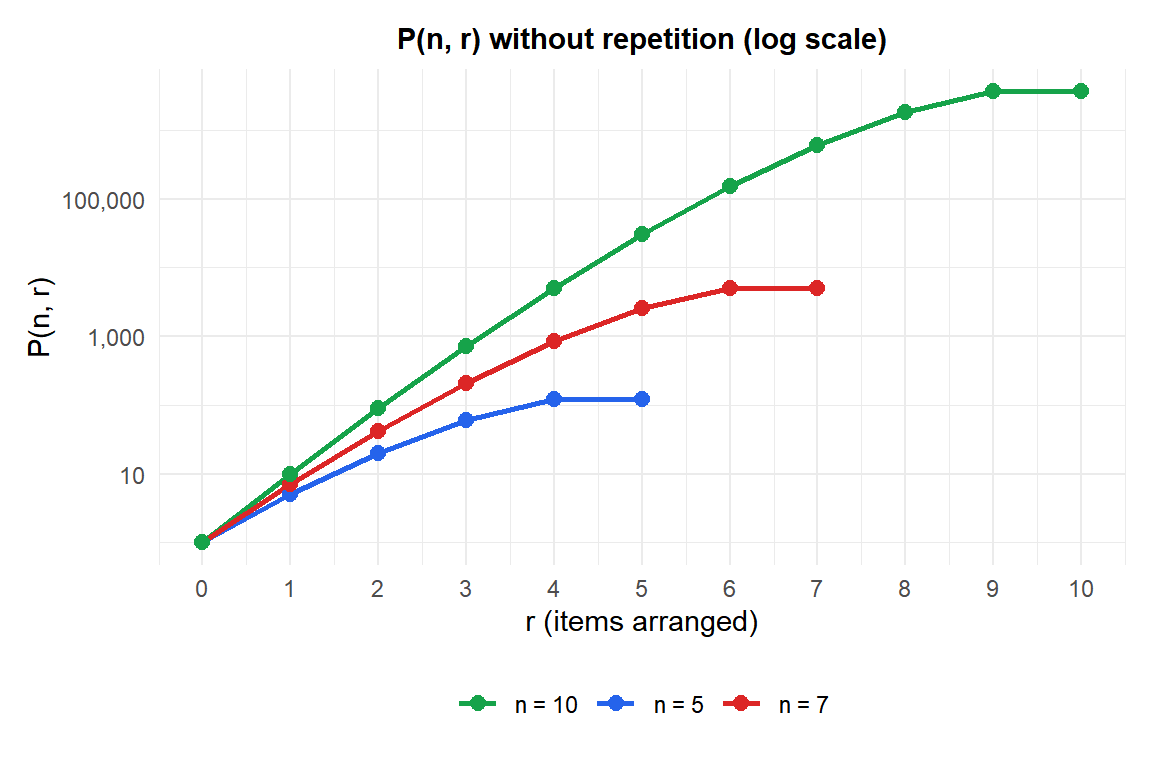
A sprint race has 8 competitors. How many different podium outcomes (gold, silver, bronze) are possible?
\[P(8, 3) = 8 \times 7 \times 6 = 336\]
The order matters: Usain winning gold and Yohan winning silver is a different outcome from Yohan winning gold and Usain winning silver.

A company interviews 12 candidates for 3 distinct positions: Director, Manager, and Analyst.
\[P(12, 3) = 12 \times 11 \times 10 = 1{,}320\]
If the positions were identical (just “hire 3 from 12”), the answer would be \(\binom{12}{3} = 220\). The distinct roles multiply the count by \(3! = 6\).
Permutations with repetition
When items can be reused, each position is filled independently from the full set of \(n\) items:
\[P_{\text{rep}}(n, r) = n^r\]
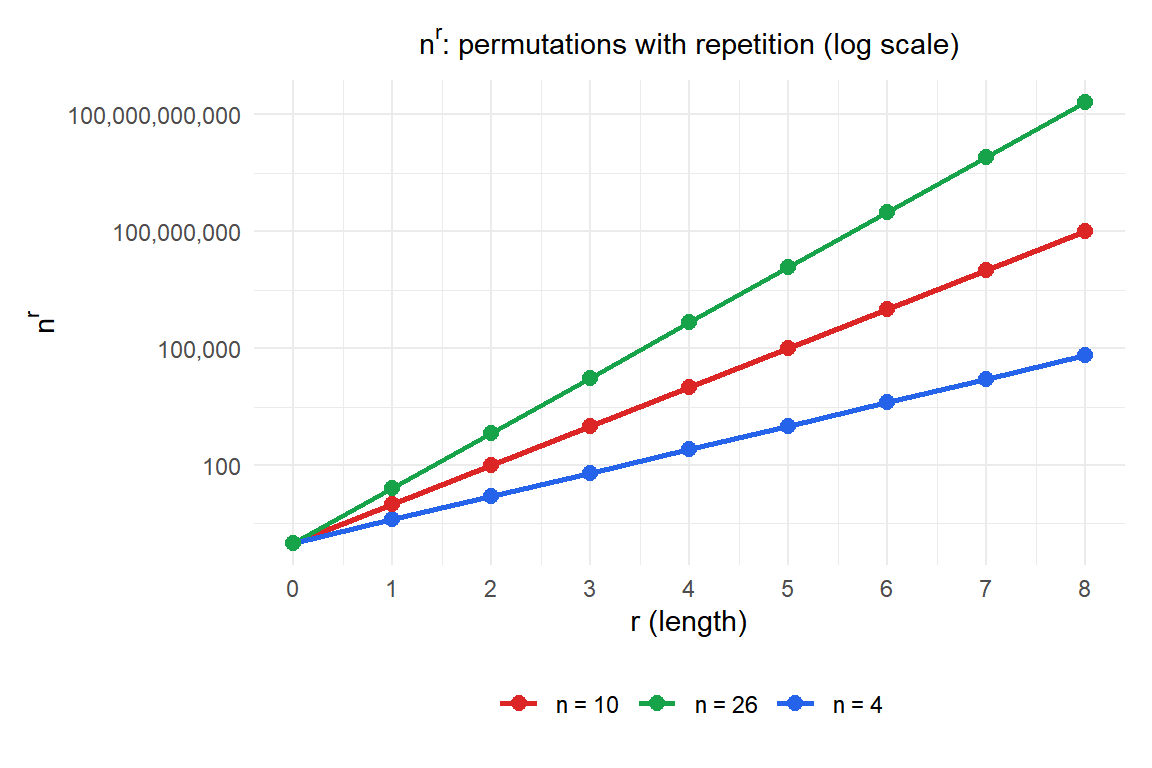
A 4-digit PIN uses digits 0-9 with repetition allowed:
\[10^4 = 10{,}000 \text{ possible PINs}\]
A password of 8 characters from 62 possible characters (26 lower, 26 upper, 10 digits):
\[62^8 \approx 2.18 \times 10^{14}\]
Each additional character multiplies the search space by 62. That is why length matters far more than complexity rules.
A secure facility uses a 6-character code from 26 uppercase letters, no repetition:
\[P(26, 6) = 26 \times 25 \times 24 \times 23 \times 22 \times 21 = 165{,}765{,}600\]
With repetition: \(26^6 = 308{,}915{,}776\). The no-repetition constraint reduces the space by about 46%.
Permutations with identical items
When some items are identical, many arrangements are indistinguishable. If \(n\) items contain groups of \(n_1, n_2, \ldots, n_k\) identical items:
\[P = \frac{n!}{n_1!\, n_2!\, \cdots\, n_k!}\]
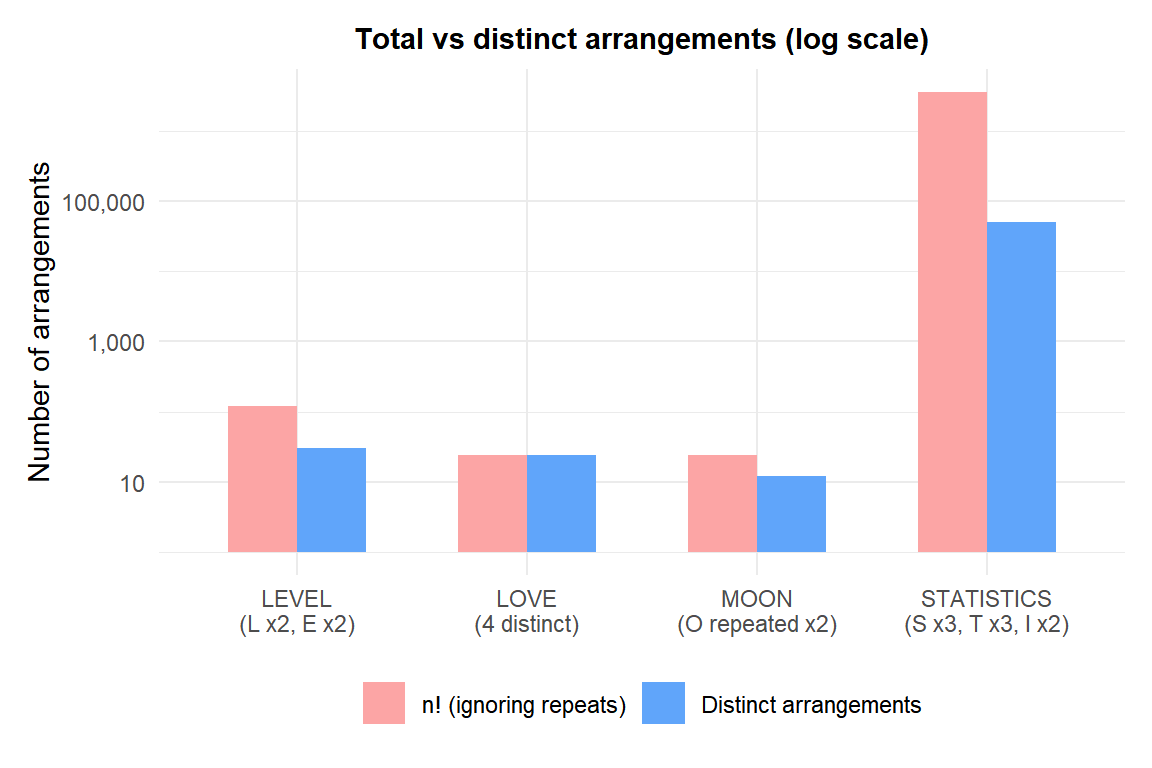
How many distinct arrangements are there of the letters in STATISTICS?
S appears 3 times, T appears 3 times, I appears 2 times, A and C once each. Total: 10 letters.
\[P = \frac{10!}{3!\, 3!\, 2!\, 1!\, 1!} = \frac{3{,}628{,}800}{72} = 50{,}400\]
Without accounting for repetitions, one might incorrectly use \(10! = 3{,}628{,}800\): 72 times too large.
More examples
Task scheduling with constraints
A project manager must schedule 6 tasks sequentially, but testing and deployment must always be last in that specific order. How many valid schedules exist?
The last 2 positions are fixed. The remaining 4 tasks fill the first 4 positions freely:
\[P(4, 4) = 4! = 24\]
Race finishing order
In a 10-car race, how many ways can the top 4 finishing positions be filled?
\[P(10, 4) = 10 \times 9 \times 8 \times 7 = 5{,}040\]
The probability that a specific set of 4 cars finishes in a specific order:
\[\frac{1}{5{,}040} \approx 0.000198\]
⚠️ Permutations assume distinct items and ordered positions
The formula \(P(n,r) = n!/(n-r)!\) requires all \(n\) items to be distinct, each position to be distinguishable, and no item reused. If items repeat, use the multinomial formula. If positions are not distinguishable, use combinations.
💡 Permutations vs combinations: the quick test
Ask: does swapping two selected items give a different outcome?
- Podium positions: yes. Use permutations.
- Committee members: no. Use combinations.
- Password characters: yes, “abc” and “bca” are different. Use permutations with repetition.
- Lottery numbers: no, the winning set is the same regardless of draw order. Use combinations.
The relationship between both: \(P(n,r) = \binom{n}{r} \times r!\). Every combination generates \(r!\) permutations.